Guide
Property Management Apps for Shared Homes
Property management apps for shared homes reduce rent chasing, chore confusion, and inspection gaps, helping landlords scale with less manual daily work.
Irving Barajas · October 5, 2026
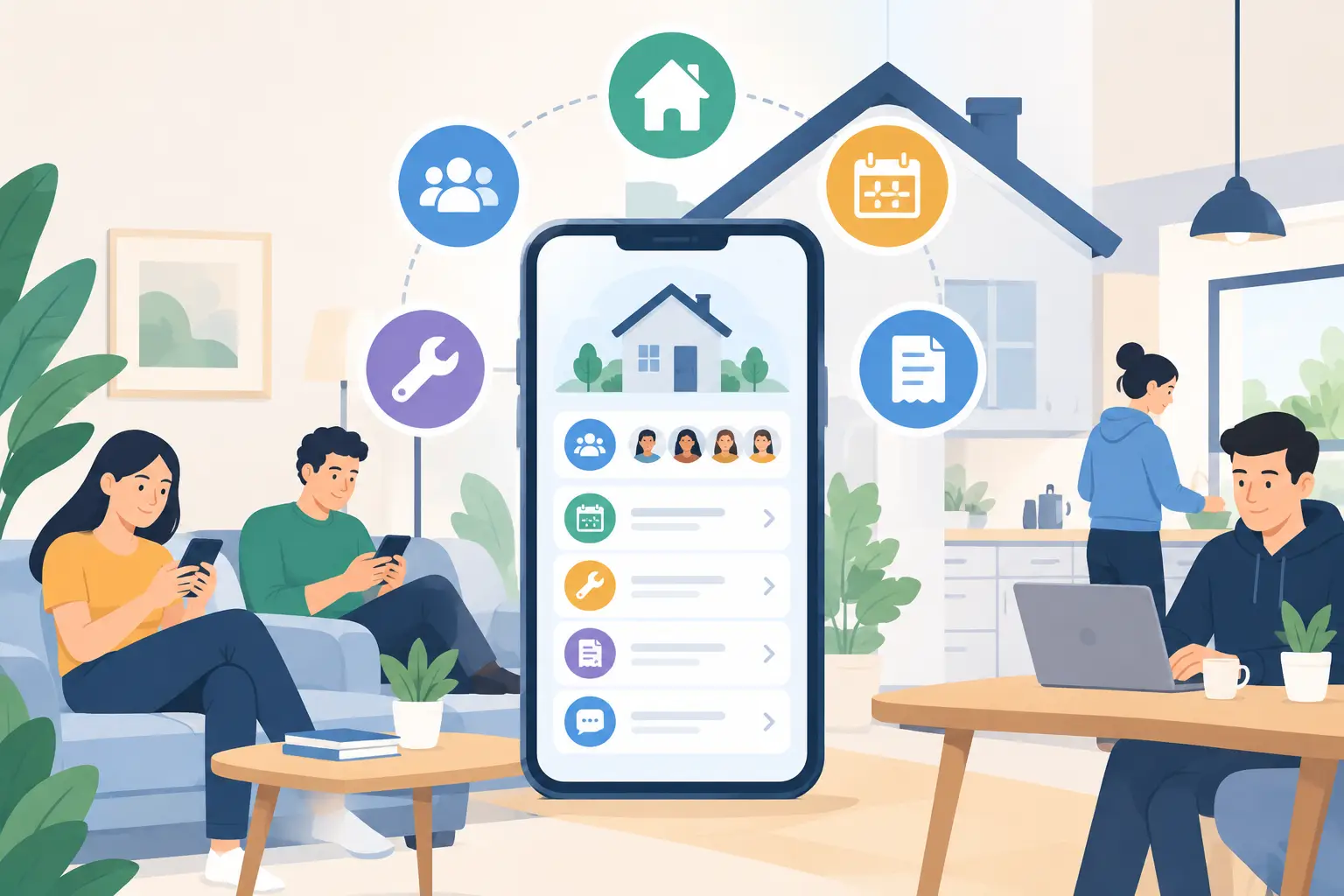
A single-family rental with one leaseholder can survive on a few calendar reminders and the occasional text. A house with five unrelated adults is different. Rent dates, chores, maintenance requests, move-ins, move-outs, and household questions all happen at the individual roommate level. That is where property management apps can either save serious time or become another login nobody uses.
For rent-by-room landlords, the goal is not to buy the biggest software package available. It is to create a repeatable operating system for the things that create the most follow-up. Less "just checking in". Fewer buried messages. More clarity about who is responsible for what.
Why shared houses need different property management apps
Traditional property management software is usually built around a unit, a lease, and a household that acts as one tenant. That works well when a couple rents an apartment together. It gets clumsy when every bedroom has a different renter, payment schedule, move-in date, and level of involvement in the house.
In a shared home, the property is not just an address with a balance due. It is a living arrangement. The landlord may need to remind one roommate about rent, assign a task to another, document a scratch in a third roommate's bedroom, and notify everyone that a plumber is coming Tuesday morning.
When those jobs live in separate texts, spreadsheets, paper checklists, and group chats, the landlord becomes the system. That is manageable at one house. It gets exhausting at three houses and nearly impossible to do consistently as the portfolio grows.
The right app organizes the work around the real experience of a shared household: individual roommates, common spaces, recurring responsibilities, and clear communication. It should make the house easier to run without making roommates feel like they are using corporate software to take out the trash.
Start with the repetitive problems
Before comparing features, look at the tasks you repeat every month. The best software decision usually starts there, not with a giant feature checklist.
Late-rent follow-up is the obvious one. Sending reminders manually may only take a minute, but it creates friction, especially when you are doing it for several people across several properties. Automated reminders give roommates advance notice and make the process consistent. You are not singling someone out because you happened to remember at 9 p.m. on the first.
Chores are another common source of low-grade chaos. If four people share a kitchen, nobody should have to remember whose turn it is to take out the trash. A rotating assignment with a clear due date turns a vague household expectation into a visible responsibility. The benefit is not that every roommate suddenly loves chores. The benefit is that there is less room for, "I thought someone else was doing it."
Move-ins and move-outs deserve the same discipline. A quick walkthrough recorded from memory is not much help when a damage question comes up months later. Digital inspections, photos, and condition notes give both the landlord and roommate a clearer record of what the room and shared areas looked like at handoff.
What to look for in an app for rent-by-room rentals
A useful platform should support the workflows that make shared housing different. If it only treats the house as one unit with one tenant record, you may end up rebuilding your current workaround inside new software.
Look first for roommate-level visibility. You should be able to see who has been assigned a task, who has completed it, who has received a reminder, and where each person is in the move-in or move-out process. That does not mean landlords need to monitor every small action. It means you should not have to search through old messages to answer a basic question.
Household communication also matters. Group chats are fast, but they are poor operating systems. Important updates disappear between memes, dinner plans, and twenty messages about a missing package. An app should give property-related reminders and notices a place where they can be found later.
Inspection tools are worth prioritizing if you manage frequent turnover. Ideally, the process lets you document room condition and common areas in a consistent format, with photos attached to the relevant item. Consistency protects your property, but it also makes expectations fairer for roommates.
Finally, pay attention to adoption. The most feature-packed platform is not helpful if a roommate needs a training session to mark a task complete. Mobile-first tools with a focused experience tend to work better in shared homes because roommates can respond where they already manage most of their day: on their phones.
The trade-off: all-in-one software is not always better
Some landlords want one system to handle accounting, leasing, maintenance, payments, communications, inspections, and chores. That can be the right choice for a larger operation, particularly if there is an office team handling multiple asset types.
But an all-in-one system often comes with a trade-off. It may be designed for conventional apartments, require more setup, and leave shared-house tasks as an afterthought. You can have a very capable accounting tool and still be texting roommates every week about chores.
For owner-operators, it can make more sense to use a focused shared-house operations platform alongside the financial tools they already trust. The question is not whether one app can do everything. The question is whether your actual pain points stop landing on your personal phone.
Cohabi, for example, is built around the room-by-room landlord workflow: automated rent reminders, rotating chores, household tasks, inspections, and roommate communication in one straightforward place. That focus matters when your business depends on keeping several unrelated adults organized without turning yourself into a full-time property manager.
Set up the system before the house gets busy
Software does not create accountability by itself. It makes accountability easier when the rules are clear from the start.
At move-in, explain how the house communicates, where roommates will see tasks and reminders, and what they are expected to acknowledge. Keep the message practical. Let roommates know that the system is there to reduce confusion, not to police them. A task assignment is better than a vague group message because everyone can see who owns it and when it is due.
For recurring tasks, build a schedule that reflects the house. A five-bedroom home with one bathroom needs a different rotation than a house where each bedroom has its own bath. Include shared responsibilities people actually notice, such as trash, kitchen cleanup, hallway upkeep, lawn coordination, and supply checks where applicable. Do not overload the schedule with every tiny behavior. A system with too many tasks becomes background noise.
For inspections, use the same checklist every time. Document bedrooms, kitchens, bathrooms, appliances, doors, walls, floors, and any furnished items. Take photos that are clear enough to be useful, not just evidence that a walkthrough happened. The value comes later, when everyone can refer to the same record instead of relying on memory.
Measure whether the app is giving time back
A new tool should earn its place in your operation. After the first month or two, ask a few direct questions: Are you sending fewer manual rent reminders? Are roommates completing tasks without individual follow-up? Can you find move-in documentation in under a minute? Are property updates less likely to get lost?
If the answer is no, the issue may be setup rather than the app itself. Perhaps notifications are off, task ownership is unclear, or the household was never told where to look. Fix the process before adding another tool.
If the answer is yes, protect that system as you grow. Copy the same inspection templates, communication rules, and chore structures to the next house, then adjust for that home's layout. Repeatability is how a landlord adds rooms without adding the same amount of management work.
A shared house will always involve people, and people occasionally need a reminder. The win is not eliminating every question or conflict. It is building a clear default for the routine stuff, so your attention is available when something actually needs a landlord's judgment.