Guide
Shared House App Review for Rent-by-Room Landlords
A shared house app review should focus on what reduces rent chasing, chore disputes, and inspection gaps for landlords who rent rooms across growing portfolios.
Irving Barajas · November 28, 2026
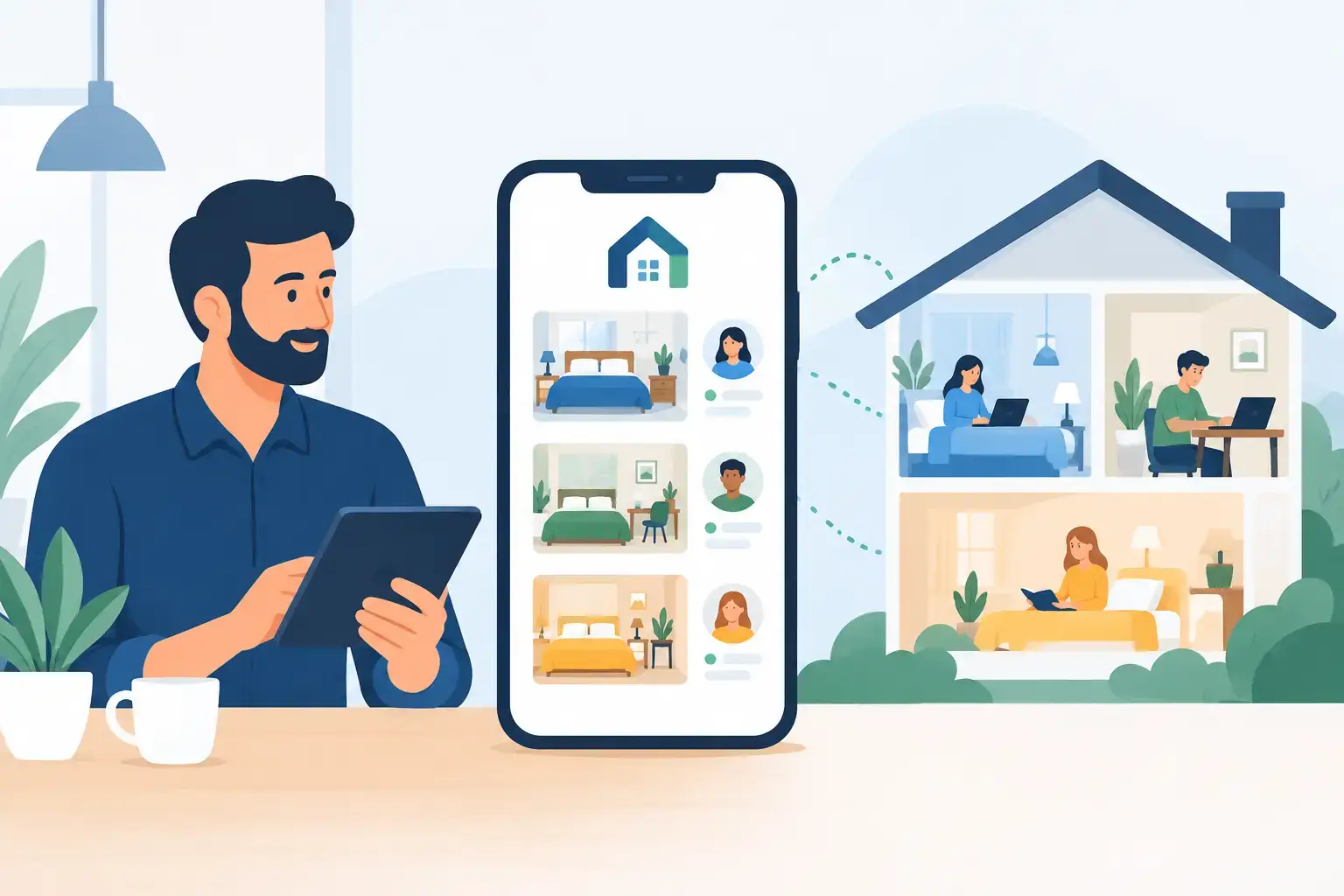
A shared house app review should not start with a long feature checklist. Start with the 8:14 p.m. text: “Who was supposed to take out the trash?” Then add three individual rent follow-ups, a maintenance issue buried in a group chat, and a move-out where nobody can find the original condition photos. That is the real operating environment of a rent-by-room property.
Traditional property management software can be useful for leases and accounting. But a shared house has a different daily rhythm. You are managing individual residents inside one home, shared spaces, rotating responsibilities, and a constant flow of small decisions. The right app reduces that operational drag without turning your business into a software project.
What a shared house app needs to solve
A shared house app is not just a portal where tenants can see a balance. For a landlord renting by the room, it should create a clear system for the work that otherwise lands in your texts, notes app, spreadsheets, and memory.
The biggest test is simple: does the app help you stop repeating yourself?
Rent reminders are a good example. When each roommate has an individual payment responsibility, a single reminder to a household group is rarely enough. One person paid last week, another is waiting on payday, and a third says they never saw the message. An app should make reminders consistent and visible without requiring you to personally chase every resident each month.
Chores matter for the same reason. A shared kitchen, bathroom, and trash area can become a source of tension fast when responsibility is vague. The goal is not to police adults. It is to make expectations clear before a landlord has to step in. If four people share a house, nobody should need to debate whose turn it is to take the bins out.
Move-ins and move-outs also deserve more attention than they usually get. Photos, condition notes, and checklists are easy to postpone when you are busy. They are much harder to recreate after a damage dispute. A useful shared-house system makes documentation part of the process rather than an extra task you may or may not remember.
Shared house app review: the features worth judging
Not every feature deserves equal weight. Some look impressive in a demo but do little to improve a Tuesday afternoon. Evaluate an app based on the recurring friction it removes from your actual operation.
Individual roommate accountability
Look for a system built around people, rooms, and households, not only whole units. In a conventional rental, one leaseholder may represent the entire apartment. In a shared house, each roommate may have their own payment date, move-in status, task assignment, and communication history.
That difference matters as your portfolio grows. A landlord with three houses and 15 roommates is not managing three simple tenant relationships. They are managing 15 individual experiences, plus three shared environments. Software should let you see both levels without making you build a maze of workarounds.
Automated reminders that do not feel personal
Manual rent follow-up is one of the least enjoyable parts of self-management. It takes time, creates awkward conversations, and is easy to handle inconsistently when life gets busy.
Automated rent reminders create a better baseline. Residents receive the same timely notice, and you are not forced to become the person sending “just checking in” messages every month. Automation will not solve a resident who cannot pay, but it does eliminate forgotten reminders and makes expectations more professional.
Check whether reminders are easy to set up and whether roommates can clearly see what action is expected. The best system is not the one with the most settings. It is the one that runs reliably after a few minutes of setup.
Rotating chores and task completion
A chore schedule on a whiteboard works until someone moves out, someone skips their week, or the board becomes part of the kitchen decor. Shared-house software should assign recurring tasks, rotate responsibilities, send reminders, and show whether work was marked complete.
There is a trade-off here. Too much monitoring can make a house feel overly managed. Too little structure leaves the most responsible roommate carrying the load. A good setup focuses on common-area basics: trash, bathrooms, kitchen cleanup, yard tasks, and simple household maintenance. Keep the process fair, visible, and proportionate to the property.
Task tracking also gives you a calmer way to address problems. Instead of relying on hearsay from the group chat, you can see what was assigned and whether it was completed. That does not eliminate every roommate disagreement, but it replaces ambiguity with a shared record.
Inspections and property condition records
For room-by-room landlords, inspections are not paperwork for paperwork’s sake. They protect the home and reduce disputes at the points where turnover is most likely to create friction.
An app should support move-in and move-out inspections with photos, notes, and clear checklists. Ideally, you can document the resident’s room as well as shared areas that may affect multiple people. A scuffed bedroom wall is different from a damaged refrigerator shelf used by the entire household.
Pay attention to usability. If inspection documentation requires several steps, separate logins, or a laptop in the driveway, it probably will not happen consistently. Mobile-first workflows matter because that is where inspections happen: standing in a bedroom, checking a cabinet, or walking through a backyard.
Communication that does not disappear into texts
Group texts are fast, but they are a poor operating system. Important messages get mixed with jokes, reactions, and unrelated conversations. A new roommate may not see the information they need. Months later, you may be scrolling through hundreds of messages trying to confirm what was said.
A shared-house app should provide a clear place for household reminders, tasks, and landlord-to-roommate communication. It does not need to replace every casual conversation. It should replace the messages that need to be found, understood, and acted on.
Where general property software can fall short
Many general property management platforms handle rent collection, listings, maintenance requests, and leases well. If you manage conventional single-family rentals or entire apartments, that may be enough.
The gap appears when your daily management depends on the household itself. General systems often treat the unit as the center of the workflow. Shared housing requires attention to the people inside that unit and the responsibilities they share.
That does not mean every landlord needs a specialized app. If you have one house, stable roommates, and a simple setup that already runs well, a spreadsheet and calendar may be perfectly adequate. But manual systems become fragile when you add rooms, turnover, or several properties. The time cost is rarely one big task. It is 20 small follow-ups every week.
What to look for before you commit
Before choosing a platform, map one ordinary month of work. Include rent reminders, chore changes, house announcements, new roommate onboarding, inspection records, and move-out follow-up. Then ask whether the app handles those moments in a way you would actually use.
Avoid buying software solely because it has a huge feature list. A system built for large apartment operators may offer advanced reporting while making a basic roommate task harder than it should be. Likewise, a lightweight roommate app may organize chores but leave you without the property documentation and landlord visibility you need.
Cohabi is designed around this middle ground: practical tools for landlords who rent by the room, including automated reminders, rotating chores, household tasks, inspections, and roommate coordination. The point is not to add another dashboard to check. It is to put repeatable shared-house work in one place.
Also consider the roommate experience. If residents cannot understand an assignment, find a reminder, or complete a task from their phone, the system will create more questions than it answers. The best app makes accountability easier for everyone without making the household feel like a corporate office.
A shared house runs better when expectations are visible, documentation is routine, and the landlord is not the only person holding the process together. Choose the app that gives your house that structure, then let it handle the repetitive stuff while you focus on the next property - or simply reclaim your evening.